Friday, August 30, 2013

Great opportunity for siblings of students with neurological differences!


For more than six years, Good Friend has been spreading its message about autism awareness, acceptance, and empathy to those who surround students with autism spectrum disorder (ASD).  Along the way, and within co-founder Denise Schamens' own family, the unique challenges that the siblings of children with ASD face have become more visible to us as an organization.  That made us especially grateful to the Autism Society of Southeastern Wisconsin for hosting a Sibshop facilitator training event  by Don Meyer, director of the Sibling Support Project, last spring in Milwaukee.

Speaker and author Don Meyer is a pioneer in the sibling movement; he has been at its forefront for more than 25 years.  He recognized the unique concerns and strengths of siblings of children with special needs ("sibs") and decided to do something to support them.  Siblings benefit, he says, from getting to know other sibs, taking in some information, being able to ask questions, and sharing the experience – good, bad or indifferent.

Sibshops offers a model intervention for sibling support, learning and fun.  It recognizes and reinforces a strengths-based approach. It also promotes relationship building between sibs through a variety of games and activities.  They reflect a belief that brothers and sisters have much to offer one another – if they are given a chance.

Sibshops are good for the soul.  They enrich the lives of the group leaders, sibling participants, and families as a whole.  They heighten public awareness that sibs matter and should not be an afterthought when it comes to supporting families of people with disabilities.

Good Friend is proud to announce our collaborative effort with Carroll University to provide Sibshops to sibs ages 8-13, who have a brother or sister with neurologically-based differences (ASD, cognitive disability, mental health challenges, etc.).  This is not to say that other disabilities aren't equally worthy of Sibshops, but that Good Friend's expertise lies in this area.

Events for the 2013-'14 school year will be held at the beautiful Carroll University Center for Graduate Studies, located at 2140 Davidson Rd., Waukesha, Wis.  Dates are Saturday mornings, starting in October: Oct. 5, Nov. 2, Dec. 7, Jan. 11, Feb. 1, (no March event) April 5, and May 3.  Each workshop will be from 9:00 a.m. to 12 noon, with a snack provided.  Registration fee is $15 per workshop or three for $30.  (In case of financial hardship that makes the registration fee prohibitive, please let us know.)

Please contact Denise Schamens for more info or to register for one or multiple dates!

Our mission power words are "Awareness Acceptance Empathy".  We teach peers in the schools to be good friends to someone with autism (and/or another brain-based disability).  Now it's time to be Good Friends to the sibs!  By educating, supporting and fostering friendships, we hope to help these precious children in their lifelong journey as Super Siblings!

We leave you with some insight from Super Sibs, as captured in Don Meyers' The Sibling Slam Book: What It's Really Like to Have a Brother or Sister with Special Needs (Woodbine House, 2005):

What life lesson have you learned from being a sib?
  • “To be understanding of other people’s difficulties, and have empathy for those who – through no fault of their own – are faced with enormous challenges, and to value each person’s unique attributes.” (Jenna H., 17)
  • “That no matter what I do he will always be there for me.  He’s my special light in the darkness; there when all other lights go out.” (Kathryn C., 14)
What’s the toughest thing about being a sib?
  • “Having to worry about the future of your sib.”  (Melisandre P., 14)
  • “I think it’s watching her fail.  The look in her eyes would send a full-grown man into tears.  Or her being denied opportunities that other kids have.” (Erin G., 14)
  • “Knowing that I will be able to do certain things someday that my sib probably won’t get to experience, like going to college, driving, or even living on my own.” (Emily P., 13)

Monday, August 19, 2013

UW-Whitewater Study of Good Friend Interventions

Last week, Denise and I attended and presented at the 6th annual WisABA Conference.  At first, the disparity between the numbers of capital letters after our last names representing our degrees and certifications was intimidating to me.  There we were, in the company of many highly-educated and -trained professionals in the fields of skilled service delivery to individuals with developmental disabilities including autism.  Their technical language was beyond my scope of understanding, in some cases.  And while I recognize and respect the appropriateness of such education and training, for certainly the population that they serve are highly-deserving of their formal preparation to provide therapeutic interventions, I appreciate the equal commitment parent-professionals like Denise and I possess.  Furthermore, we recognize the equal devotion to positive, measurable outcomes of our interventions.

Good Friend's desire to establish an evidence basis for our services was innate.  Since 2008, we'd been seeking an independent researcher to study the effectiveness of our interventions.  Because our interventions are with the classmates and educators surrounding the students with autism spectrum disorder (ASD), we knew the validation study would have to include hundreds of participants in dozens of services.

Though our first collaboration with UW-Madison disintegrated when the professor left for a position out-of-state, another door opened in 2010 through UW-Whitewater.  Dr. Simone DeVore met with Chelsea Budde and Denise Schamens to discuss the possibility of initiating a study of Good Friend’s elementary school services.   In 2011, Dr. DeVore and her colleague, Dr. Brooke Winchell, were able to observe our staff and student trainings and develop tools to measure change following our staff in-services and Peer Sensitivity Workshops (PSWs) for grades 3-5.  They then drafted a proposal to the university’s Institutional Review Board for the Protection of Human Subjects (IRB) for approval to allow us to move forward with a pilot study.  Finding willing schools to participate in the pilot in the spring of 2012 paved the way for the next phase, which was the finalization of the tools and application for IRB approval of the full study.

The recruitment of participating schools began in the summer of 2012, with Letters of Affiliation from the University and Presentation Agreements from Good Friend.  Services were conducted between September, 2012, and May, 2013, at no charge to the host schools, but the school administrators were required to get consent from the students’ families to participate.  The schools also helped administer the pre- and post-intervention surveys, which contained both quantitative and qualitative questions.  In the end, the stack of data pictured in the last blog entry was the harvest of three years of collaboration, and was collected from some 800 participants.

Dr. DeVore and Dr. Winchell presented the findings to Denise and me earlier this month.  Based on the data collected through the study, we can say that Good Friend’s PSWs “highly influence” students’ survey answers regarding their understanding about autism (its cause and manifestations), their likelihood to interact with classmates with autism, and their comfort with doing so.  Data collected from the staff in-services highlights improved understanding of available resources, knowledge of strategies for disability harassment intervention, and confidence in working with their students with autism.

Some recurring appreciations from staff include the authenticity of our examples and personal stories, the common language we're able to provide participants, and the relevant resources we're able to explain and connect them with.  What they regret is not having the trainings earlier in the school year and more time to troubleshoot!  In some of the peer participants' comments, it's clear they've absorbed key concepts and are using the terminology accurately!

Denise is looking forward to attending Dr. Winchell's co-presentation with Dr. DeVore of "Autism Peer Intervention Validation Study: Promoting Teacher Knowledge and Peer Sensitivity", based on the research Council for Children with Behavioral Disorders’ annual conference in Chicago, Ill., next month.  The professors are also creating a presentation proposal for the university's Early Childhood Conference (April, 2014).  Furthermore, they are initiating a text analysis of six years’ worth of Good Friend student question cards collected during Good Friend's PSWs.
findings, at the

We are taking the study-based recommendations from the professors and tweaking our services, with the intention of collaborating again with the University in the coming years to do both PSW student subject case studies and longitudinal studies on PSW classrooms.

Frankly, it's a great time to hop on the Good Friend bandwagon!  If you'd like to contribute your time and talent to our mission, we'd be glad to have you!  Contact me or Denise and we'll get you plugged in.

Tuesday, August 6, 2013

A BIG week!

Sometimes, Mondays ROCK!  And yesterday was one of them.  Good Friend kicked off an exhilarating, exhausting week Monday morning with a summary of the findings of the research study conducted by two professors at University of Wisconsin-Whitewater.  We're reserving the best bits of news for the guests of our annual Member Appreciation Night this Friday!  But what we can say is that both our staff in-services and Peer Sensitivity Workshops make a measurable, positive difference in expanding autism awareness, acceptance, and empathy!  Denise and I are still trying to wrap our heads around the magnitude of Simone DeVore and Brooke Winchell's findings, which will be presented at the Council for Children with Behavioral Disorders' annual conference in Chicago next month.
Dr. Brooke Winchell had her work cut out for her as she began to pour over the raw data from the surveys UW-W collected during Good Friend staff in-services and Peer Sensitivity Workshops in the 2012-'13 school year.

Zooming back to host the first of our two open casting calls for "We ALL Fit", our new elementary school peer autism awareness short film, we shifted from one excitement to another.  We met 23 hopefuls for the project, and are realizing we'll have some difficult decisions to make once we complete today's session.  We welcome you to audition!  We have some specific profiles we're looking for, and no acting experience is necessary.  Here's the list:

  • girl with autism, age 6-10, who has some reliable spoken language
  • boy with autism, age 7-11, who uses a type-to-speak device
  • boy age 2-4, dark-haired
  • girl age 2-4, blonde-haired, willing to have a tantrum for the camera
  • extras: six 10-11 year-olds (mix of boys and girls), three adults (age 25-65), two 12-15 year-olds

Just show up at Citizens Bank of Mukwonago in Waukesha near Center Rd. and Hwy. 59 and go upstairs to the Training Center between noon and 3 p.m. TODAY for a quick on-camera audition.  Call Denise at 262-391-1369 with any questions.

We hope to introduce you to at least a few of our 30 newly-chosen cast members at Friday's Member Appreciation Night.  How many more reasons do you need to join us??  Awards, celebrations, new study findings, an Aaron Rodgers autographed football up for grabs ... PHEW!  Like I said, it's a BIG week!  If you plan to be at Steinhafels in the Community Room at 7 p.m. on Friday, please email Denise if she doesn't know already.

Wednesday, July 24, 2013

Keep On Moving!

We have MOMENTOUS things to celebrate now and in the coming weeks!

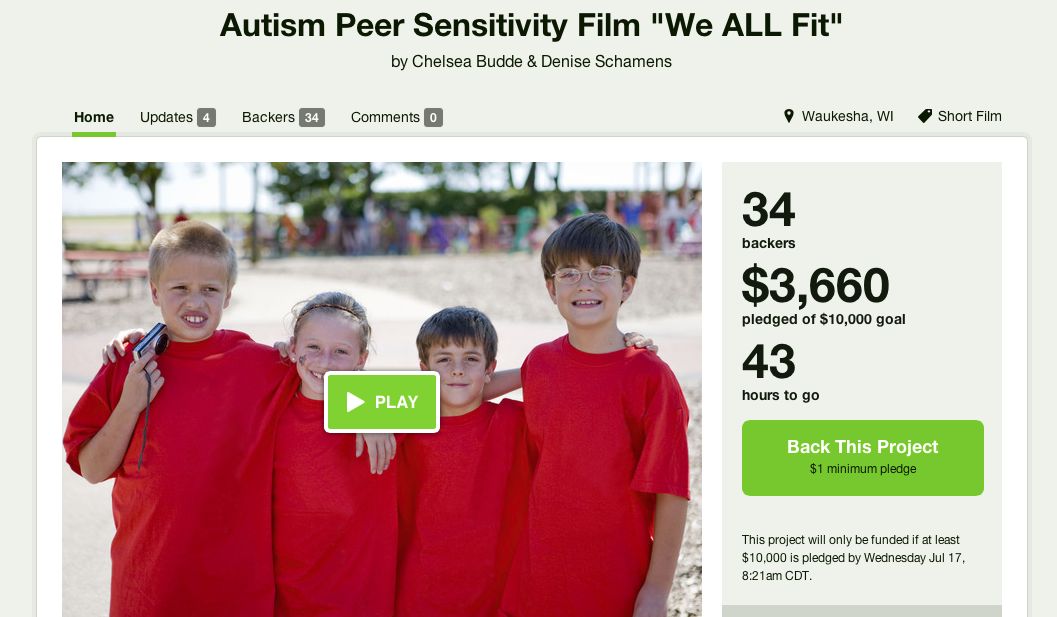
First, we successfully completed our $10,000 Kickstarter crowd-funding project for our new elementary school autism peer sensitivity film!  Yahooooo!!!  Special thanks to Rob Lindemann for his $500 donation.  Because of Rob and other people who believe in our Awareness-Acceptance-Empathy mission, we are able to move forward with our casting call August 5 & 6.  If you still want to donate to this project, we will gladly accept your donation via our website or by mail and will be happy to honor the rewards promised through the Kickstarter campaign at the $25, $100, and $1,000 levels.

Second, Denise and I are excited to be meeting with University of Wisconsin-Whitewater professors Simone DeVore and Brooke Winchell next month to discuss the findings of their research study on our elementary school interventions.  This was a HUGE undertaking, spanning almost three years and involving over 1,200 participants.  We hope to have some insights to share at our annual Member Appreciation Night on August 9th!

FinallyGood Friend, Inc., celebrates is 6th "birthday" on August 10th.  Our "party" is wrapped up as part of our annual Member Appreciation Night on August 9th, when we'll raise our cupcakes to last fiscal year's Top Fundraiser, Dani Rossa, and Good Friend in Education Award winner Miranda Probst.  Plan to join us that Friday evening from 7-8:30 p.m. at Steinhafels in Waukesha! 

This football, autographed by Aaron Rodgers, will be up for auction!  Let Denise know you're coming by August 2nd, please.  And feel free to bring guests!

We appreciate your continued support as we work together to create cultures of acceptance in our schools!  (And it's not too early to schedule fall services for staff and students, by the way.)

Monday, July 15, 2013

TICK TOCK: Less than two days remain!

We are now in the hourly countdown of our KICKSTARTER crowd-funding campaign!  With some additional donations made to our website and by check by Benny B., Pamme W., Les & Jeannette S., and others, I was able to post a large pledge for "We ALL Fit".  We are now in a mad dash to find $6,400.  Donations made via Amazon payments (with a credit card or Amazon account) are tax-deductible, minus the value of any reward a backer chooses (if any).

Watch the 3:40 video at http://kck.st/126nroy!
Will you please share this project with at least five people and/or businesses today?  Apparently, 30 days is too short a time to tell prospective backers about the value of this film!  But if we don't raise all $10K, we get NOTHING.

Special thanks to $100 backers Megan Dabols, Jackie Dorshorst, Shelly Dretzka, Jake Gould, and Jane Menheer!

In anticipation of the film being fully-funded, we have scheduled open auditions in Waukesha!  Choose which session you'd like to attend: Monday, August 5, from 4 to 7 p.m., or Tuesday, August 6, from noon to 3 p.m.  Each audition should only take a few minutes, but you may have to wait.  Since we're looking for quite a few students with autism spectrum disorder (ASD) in addition to children of typical neurology, if you have a kiddo who can't wait for his or her audition, please contact me (414-510-0385) to set up a specific appointment.  We'll be upstairs in the Training Center of Citizens Bank of Mukwonago (Waukesha office).  Check out the Facebook event for more information.

We're so glad you're with us every step of the way for this elementary school peer sensitivity film!

Monday, July 8, 2013

You Are Invited

You are invited to make a difference.  You are invited to be an inspiration.  You are invited to celebrate friendship.  You are invited to participate!

So far, 21 of you have accepted our invitation to participate in backing our new autism peer sensitivity film, "We ALL Fit".  Special thanks to $100 backers Kim Braatz, Jessica Lowney, Mike Rubingh, and Melanie Walsh!  While the KICKSTARTER campaign is currently reflecting $1,585 in pledges, I have another $600 here from donors who've mailed checks.  THANK YOU!  That puts our project at nearly 22% funded, and we only have a week left of this campaign!  If we don't get $10,000 in pledges by the morning of July 17, the pledges made will not be collected.  So PLEASE -- if you are able to participate by pledging, sharing the campaign via word-of-mouth, email, or social media, or both, DO SO NOW.  This is not a Save-the-Date, but an urgent plea!  Here's the shortened URL: http://kck.st/126nroy

Good Friend co-founder Denise Schamens invited me to help her make our first video more than six years ago.  She and I have developed a rather productive synergy over the short but impactful life of our nonprofit organization.  Without the distractions of home, I managed to get the script written while on vacation, bouncing ideas off her as inspired.  Now Denise is making her final reviews before we release the script to the critique of a broader audience.  That means open auditions are coming soon!  I can tell you that this will be a LARGE cast, and we're looking for a group of some 20 children ages 5-11 (mostly 10- to 11-year-olds), diverse in both their neurology and ethnicity.  We'll also need a few adults.  For details as they're released, join the open Facebook group, Theatre Auditions for Southeastern Wisconsin.  You are invited to audition!

Friday, August 9, from 6:30-8:30 p.m., will be our 6th annual dessert reception Member Appreciation Night at Steinhafels' Community Room in Waukesha, Wis.  Don't let the name fool you -- you don't have to be a member to celebrate with us!  We will be honoring a very special student from Park Lawn Elementary School (Oconomowoc) who embodies our Good Friend autism awareness-acceptance-empathy message.  There will be entertainment, goodies, and information about our organization.  If you're someone who thinks our schools should be places where we foster healthy social-emotional development, you should plan to attend!  Paper invitations will be mailed to our members automatically.  If you want to be included on the mailing list, email me your address.

We also invite you to join Team Good Friend for Autism Society of Southeastern Wisconsin's Dylan's Run/Walk!  The event is on Sunday, Sept. 8, but we need to get our team squared away by Wednesday, August 7!  We have appreciated the support of ASSEW for our first two films, as well as for all they've done for our community.  This event has been fun to participate in ... and then stay for Indian Summer Festival.

What invitations will you accept??

Monday, June 24, 2013

Autism: an explanation -- not an excuse

Even though Denise Schamens and I have been providing Peer Sensitivity Workshops through Good Friend for nearly six years now, we are still often met with resistance about explaining a classmate with autism spectrum disorder's (ASD) differences.  And we respect that.  But admittedly, it makes us a little sad, because we've seen the benefit talking about autism early conveys!  Yet when we learn the resistance is due to a misunderstanding about the intention of our services, we like to clear the air.

For example, a school's administration was encouraging parents of students with ASD to sign a consent form allowing us to contact them to discuss their child.  A spontaneous discussion began among the parents of students identified through their IEPs has having autism who had received the consent form.  While some families were all for the disclosure for the sake of creating positive interactions between students, one family in particular was discouraging others, suggesting that we would offer "excuses" for the "bad behavior" of students with autism.

Indeed, most children (and adults, for that matter) have some undesirable or bad behaviors, whether or not they have ASD.  And as caregivers, we have to strive to redirect or otherwise extinguish those behaviors, because we recognize them as chosen.  Yet in learners with autism, many of those "behaviors" are not chosen at all.  They are a product or a side effect of the differently-wired brain.  In other words, when similar undesirable behaviors are seen in a neuro-typical 5-year-old and an 8-year-old with ASD, we have to distinguish between the meaning of the behaviors and act (or better yet, preempt) accordingly.

When students with ASD have a functional behavior assessment, we caregivers have a head start in our ability to understand and explain unexpected behaviors.  Because autism is an "invisible disability", a neuro-typical student is not likely to associate a peer's unexpected behavior with a differently-wired brain.  But once we provide an explanation about autism and the diverse way that student experiences the world around him, the other students will no longer be mystified about the behavior.

It's not to say that an unsafe behavior like hitting would become acceptable.  Certainly, regardless of the communicative intent of the behavior, unsafe actions have no place in a classroom.  But explaining to the other students who've found better ways to cope with their frustrations or anxieties that there's a whole team of support people (educators, therapists, etc.) working together to teach the student with autism other coping strategies goes a long way.  Typically-developing peers could go from being hesitant or even fearful to being cooperative and helpful.

What have you learned about autism through the behavior of your person with ASD?