Showing posts with label autism awareness. Show all posts

Wednesday, April 9, 2014

Six Weeks of Pure Awesome

March and April are hands down Good Friend, Inc.'s busiest months.  We're right in the thick of our two big annual fundraising events: the ongoing Highlight It Up Blue campaign, which this year involves four stylists and runs through April 23; and our Hoa Aloha Autism Awareness Bowling Event, coming up on this Sunday, April 13.

If you indicated you're "Attending" our Highlight It Up Blue Facebook event, you've seen some of the pictures.  We've doubled the number of schools participating in this year's campaign, and again have had to turn some away (sorry!) because so many communities are lining up to support autism awareness, acceptance, and empathy.  To date, here are the top five leaders and their gross receipts:

  1. Rose Glen Elementary (Waukesha) - $985
  2. Waukesha STEM Academy-Randall - $725
  3. Park Lawn Elementary (Oconomowoc) - $600
  4. Mukwonago High School - $520
  5. Butler Middle School (Waukesha) - $470

Waukesha STEM Academy-Saratoga and Waukesha West High School also participated.  We'll be at Heyer Elementary (Waukesha), Edgerton Elementary (Hales Corners) and Waukesha South High School before it's all over.  THANK YOU for helping push us toward our goal of raising $7,000 to facilitate our staff and student trainings in elementary and middle schools!

How are you involved in this Sunday's BIG event at New Berlin Bowl?  We have some 200 bowlers registered on teams, plus more than a dozen volunteers and nearly 100 donors.  There are lots of opportunities for you to get in on the action!  Thursday is the last day to register or donate online.  If you show up on Sunday, we'll try to get you on a lane as they're available.  The morning (10:30 a.m.) start time should still have openings.  Even if you're not bowling, you won't be bored!  Check out some of our silent auction items:
two different "Beach Day" buckets, starting bid = $10
"Kids' Entertainment" basket, starting bid = $45

This is one of eight images in the framed 28" x 34" "Hearts" print, starting bid = $60


Green Bay Packers autographed football, starting bid = $100
pair of admission tickets, starting bid = $45


"Outdoor Fun" package, starting bid = $10

"Indoor Fun" package, starting bid = $20
And our raffle items include this stunning pair of diamond stud earrings from Diamond Nexus and a VIP game package for four from the Milwaukee Brewers!  Tickets are $5 for one or $20 for five.  Choose which prize container you want to put your tickets in.  Need not be present to win.  Drawing is at 3 p.m.

All of this goodness facilitates the good work of Good Friend: going in to schools, colleges, universities, and summer camps to lay the groundwork for positive, healthy social interactions between children with autism and their peers.  If you need more information on any of these RIGHT NOW opportunities, please contact chelsea@goodfriendinc.com, or call 414-510-0385.

Monday, August 19, 2013

UW-Whitewater Study of Good Friend Interventions

Last week, Denise and I attended and presented at the 6th annual WisABA Conference.  At first, the disparity between the numbers of capital letters after our last names representing our degrees and certifications was intimidating to me.  There we were, in the company of many highly-educated and -trained professionals in the fields of skilled service delivery to individuals with developmental disabilities including autism.  Their technical language was beyond my scope of understanding, in some cases.  And while I recognize and respect the appropriateness of such education and training, for certainly the population that they serve are highly-deserving of their formal preparation to provide therapeutic interventions, I appreciate the equal commitment parent-professionals like Denise and I possess.  Furthermore, we recognize the equal devotion to positive, measurable outcomes of our interventions.

Good Friend's desire to establish an evidence basis for our services was innate.  Since 2008, we'd been seeking an independent researcher to study the effectiveness of our interventions.  Because our interventions are with the classmates and educators surrounding the students with autism spectrum disorder (ASD), we knew the validation study would have to include hundreds of participants in dozens of services.

Though our first collaboration with UW-Madison disintegrated when the professor left for a position out-of-state, another door opened in 2010 through UW-Whitewater.  Dr. Simone DeVore met with Chelsea Budde and Denise Schamens to discuss the possibility of initiating a study of Good Friend’s elementary school services.   In 2011, Dr. DeVore and her colleague, Dr. Brooke Winchell, were able to observe our staff and student trainings and develop tools to measure change following our staff in-services and Peer Sensitivity Workshops (PSWs) for grades 3-5.  They then drafted a proposal to the university’s Institutional Review Board for the Protection of Human Subjects (IRB) for approval to allow us to move forward with a pilot study.  Finding willing schools to participate in the pilot in the spring of 2012 paved the way for the next phase, which was the finalization of the tools and application for IRB approval of the full study.

The recruitment of participating schools began in the summer of 2012, with Letters of Affiliation from the University and Presentation Agreements from Good Friend.  Services were conducted between September, 2012, and May, 2013, at no charge to the host schools, but the school administrators were required to get consent from the students’ families to participate.  The schools also helped administer the pre- and post-intervention surveys, which contained both quantitative and qualitative questions.  In the end, the stack of data pictured in the last blog entry was the harvest of three years of collaboration, and was collected from some 800 participants.

Dr. DeVore and Dr. Winchell presented the findings to Denise and me earlier this month.  Based on the data collected through the study, we can say that Good Friend’s PSWs “highly influence” students’ survey answers regarding their understanding about autism (its cause and manifestations), their likelihood to interact with classmates with autism, and their comfort with doing so.  Data collected from the staff in-services highlights improved understanding of available resources, knowledge of strategies for disability harassment intervention, and confidence in working with their students with autism.

Some recurring appreciations from staff include the authenticity of our examples and personal stories, the common language we're able to provide participants, and the relevant resources we're able to explain and connect them with.  What they regret is not having the trainings earlier in the school year and more time to troubleshoot!  In some of the peer participants' comments, it's clear they've absorbed key concepts and are using the terminology accurately!

Denise is looking forward to attending Dr. Winchell's co-presentation with Dr. DeVore of "Autism Peer Intervention Validation Study: Promoting Teacher Knowledge and Peer Sensitivity", based on the research Council for Children with Behavioral Disorders’ annual conference in Chicago, Ill., next month.  The professors are also creating a presentation proposal for the university's Early Childhood Conference (April, 2014).  Furthermore, they are initiating a text analysis of six years’ worth of Good Friend student question cards collected during Good Friend's PSWs.
findings, at the

We are taking the study-based recommendations from the professors and tweaking our services, with the intention of collaborating again with the University in the coming years to do both PSW student subject case studies and longitudinal studies on PSW classrooms.

Frankly, it's a great time to hop on the Good Friend bandwagon!  If you'd like to contribute your time and talent to our mission, we'd be glad to have you!  Contact me or Denise and we'll get you plugged in.

Monday, July 15, 2013

TICK TOCK: Less than two days remain!

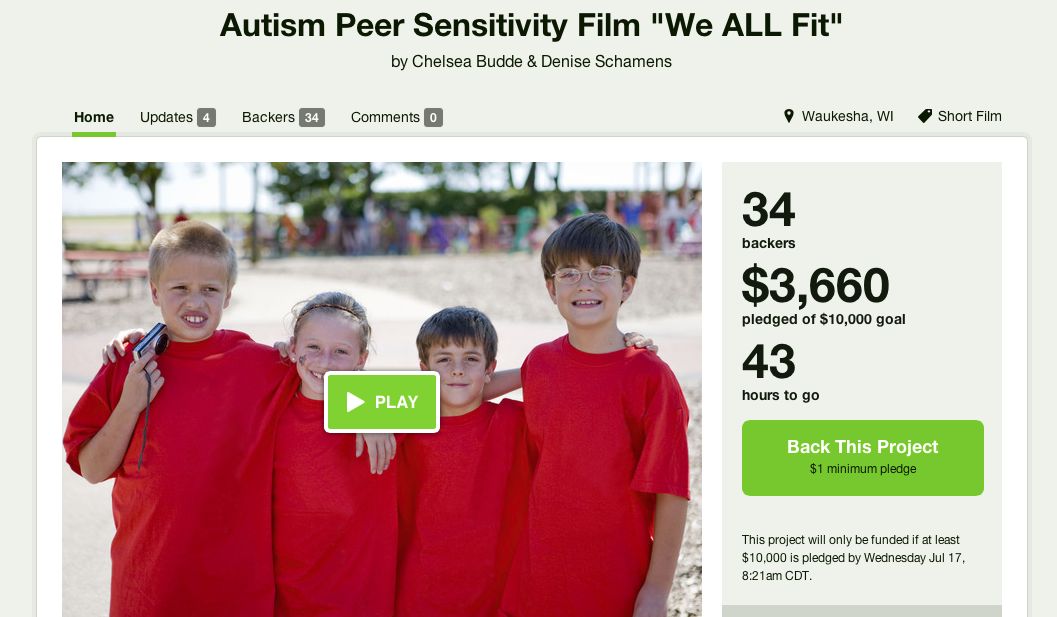
We are now in the hourly countdown of our KICKSTARTER crowd-funding campaign!  With some additional donations made to our website and by check by Benny B., Pamme W., Les & Jeannette S., and others, I was able to post a large pledge for "We ALL Fit".  We are now in a mad dash to find $6,400.  Donations made via Amazon payments (with a credit card or Amazon account) are tax-deductible, minus the value of any reward a backer chooses (if any).

Watch the 3:40 video at http://kck.st/126nroy!
Will you please share this project with at least five people and/or businesses today?  Apparently, 30 days is too short a time to tell prospective backers about the value of this film!  But if we don't raise all $10K, we get NOTHING.

Special thanks to $100 backers Megan Dabols, Jackie Dorshorst, Shelly Dretzka, Jake Gould, and Jane Menheer!

In anticipation of the film being fully-funded, we have scheduled open auditions in Waukesha!  Choose which session you'd like to attend: Monday, August 5, from 4 to 7 p.m., or Tuesday, August 6, from noon to 3 p.m.  Each audition should only take a few minutes, but you may have to wait.  Since we're looking for quite a few students with autism spectrum disorder (ASD) in addition to children of typical neurology, if you have a kiddo who can't wait for his or her audition, please contact me (414-510-0385) to set up a specific appointment.  We'll be upstairs in the Training Center of Citizens Bank of Mukwonago (Waukesha office).  Check out the Facebook event for more information.

We're so glad you're with us every step of the way for this elementary school peer sensitivity film!

Monday, July 8, 2013

You Are Invited

You are invited to make a difference.  You are invited to be an inspiration.  You are invited to celebrate friendship.  You are invited to participate!

So far, 21 of you have accepted our invitation to participate in backing our new autism peer sensitivity film, "We ALL Fit".  Special thanks to $100 backers Kim Braatz, Jessica Lowney, Mike Rubingh, and Melanie Walsh!  While the KICKSTARTER campaign is currently reflecting $1,585 in pledges, I have another $600 here from donors who've mailed checks.  THANK YOU!  That puts our project at nearly 22% funded, and we only have a week left of this campaign!  If we don't get $10,000 in pledges by the morning of July 17, the pledges made will not be collected.  So PLEASE -- if you are able to participate by pledging, sharing the campaign via word-of-mouth, email, or social media, or both, DO SO NOW.  This is not a Save-the-Date, but an urgent plea!  Here's the shortened URL: http://kck.st/126nroy

Good Friend co-founder Denise Schamens invited me to help her make our first video more than six years ago.  She and I have developed a rather productive synergy over the short but impactful life of our nonprofit organization.  Without the distractions of home, I managed to get the script written while on vacation, bouncing ideas off her as inspired.  Now Denise is making her final reviews before we release the script to the critique of a broader audience.  That means open auditions are coming soon!  I can tell you that this will be a LARGE cast, and we're looking for a group of some 20 children ages 5-11 (mostly 10- to 11-year-olds), diverse in both their neurology and ethnicity.  We'll also need a few adults.  For details as they're released, join the open Facebook group, Theatre Auditions for Southeastern Wisconsin.  You are invited to audition!

Friday, August 9, from 6:30-8:30 p.m., will be our 6th annual dessert reception Member Appreciation Night at Steinhafels' Community Room in Waukesha, Wis.  Don't let the name fool you -- you don't have to be a member to celebrate with us!  We will be honoring a very special student from Park Lawn Elementary School (Oconomowoc) who embodies our Good Friend autism awareness-acceptance-empathy message.  There will be entertainment, goodies, and information about our organization.  If you're someone who thinks our schools should be places where we foster healthy social-emotional development, you should plan to attend!  Paper invitations will be mailed to our members automatically.  If you want to be included on the mailing list, email me your address.

We also invite you to join Team Good Friend for Autism Society of Southeastern Wisconsin's Dylan's Run/Walk!  The event is on Sunday, Sept. 8, but we need to get our team squared away by Wednesday, August 7!  We have appreciated the support of ASSEW for our first two films, as well as for all they've done for our community.  This event has been fun to participate in ... and then stay for Indian Summer Festival.

What invitations will you accept??

Monday, June 17, 2013

LAUNCHED: Campaign for New Film Project

We've been planning for this for a looooooooong time (just ask Good Friend co-founder Denise Schamens -- she'll tell you): the official start of our new elementary school film project!  It's hard to believe it's been three years since we started work on Choosing To Be a GFF for middle school, and that How Can I Be a Good Friend to Someone with Autism, our first film, was released nearly six years ago!

If you saw our award-winning middle school film, you know how much we grew as filmmakers between our first and second productions.  Can you imagine what our THIRD will be like?  We sure can.  And we have quite a crew assembled who will make it come to pass.

Want to be part of the action?  Check out and share our KICKSTARTER campaign!  We need people to catch the creative vision we have to make this film come to life.  We have less than 30 days (until the morning of July 17) to find $10,000 in pledges.  Here are a few things you should know about this platform and our specific project for We ALL Fit (the title of our upcoming film):

  • Because Good Friend is a 501(c)(3) public charity, donations made through the campaign are tax-deductible as allowed by law.  However, if you receive a "Reward" through the campaign, the cash value of the reward is not considered tax-deductible.  Therefore, your acknowledgement from Good Friend will reflect the difference.
  • If you pledge an amount other than those listed on our Rewards section, you may still be eligible for Rewards.  Email us for more info.
  • Kickstarter uses Amazon Payments to collect pledges, but will not do so until after our campaign has ended (July 17) and ONLY IF we meet our $10,000 goal.  You do not need an Amazon account to make a pledge.
  • Backers could be anywhere, and time is of the essence. Help us find them. Please spread the word via email and social media.


We would be negligent if we didn't offer shout-outs to some key players to date in this project ...

  • Our creative team, including returning techies Dan Kallenberger and Tim Miller.  You two have been SO patient with us as budding filmmakers and incredibly supportive with our last two projects.  THANK YOU for being on board this time and bringing some fresh talent with you!
  • Greg Marshall of Figureheads, Inc.  Our meeting was no accident, and this collabo is going to be EPIC!
  • The participants of our May 2012 Community Conversation on Meaningful Inclusion in Elementary School. Your energy that night was inspiring, and made us realize there's NOTHING we can't accomplish when we as parents, therapists, educators, and administrators work together!  (And though I promised notes more than a year ago, they really ARE coming this week!)


Thanks to each of you for BACKING our mission!

Monday, April 8, 2013

What comes after Awareness?

It's a busy month in the Good Friend calendar: Autism Awareness Month.  We caregivers are all bustling about with blue in our 'dos and shining our lights and wearing our puzzle piece pins.  And as my own children with ASD get older (they're now 14 and 11), they're taking more notice of all the buzz.  As they take more notice and I explain in more depth, it all adds to their self-awareness.  So in our household, Autism Awareness Month really is a triple threat (and I mean that in a benign way): It's important to me as a mom, to our organization's work, and to my kids as people with ASD.

One of the tweets I (follow ChelseaMB) posted on World Autism Awareness Day was met with the following question: "after aware, then what?" [sic].  For me, the reply took far fewer than 140 characters and was instant:  Just what #GoodFriendInc stands for: ACCEPTANCE and EMPATHY!  I didn't need to ponder that.  It's what I've been focused on through Good Friend for the last five years, and even longer as a mom.

Good Friend's philosophy is that you can't explain what you can't name, so Awareness is step one.  That's what makes Autism Awareness Month so foundational.  But it cannot stop there.  Once we are aware, we work toward understanding.  Understanding leads to Acceptance.  That's step two.  When we move into understanding autism on an experiential level, we foster Empathy.  This is the step where the magic happens.  Once we've felt what it might be like for our friends with autism, we can become natural supports for them.  We will remember what we've learned when we see our friend or colleague with autism struggling, and will respond in a constructive -- versus judgmental -- way.

Constructive responses lead to successful interactions.  And more than anything else, success begets success.

So while I realize that blue for autism in April won't create autism-friendly jobs in May, it certainly does create opportunities for discussions!  Seize those opportunities to discuss with your students, your co-workers, and your community members.  Create awareness of the strengths of individuals with ASD.  Create awareness of the resources in your community, or discuss what's lacking and call the stakeholders to the collaborative table to figure out how it can be manifested.  Self-advocates: Improve self-awareness of your talents and capitalize on them.  Become aware of what supports might be there for you and put those tools in your toolbox.

Awareness is the foundation; keep building!

Monday, March 18, 2013

HighLight It Up Blue, year 2!


Welcome to the 2nd annual Good Friend HighLight It Up Blue for Autism campaign!  Last year, well over 100 of you in the metro Milwaukee area visited Salon BrillarĂ© in Pewaukee, or went to one of our on-location events in Waukesha, New Berlin, or Milwaukee, to get blue natural hair extensions, feathers, and/or sparkly tinsel strands to help create autism awareness.  This year, we've added two more stylists and locations!

Not only will Janet D'Amato be taking appointments at Salon BrillarĂ©, but also Erin Hitt at Merle Norman Salon (Brookfield Square) and Gina Andrade of Hair by Gina (a Solo Salon, Waukesha)!  For $10, clients can choose one product, or pump it up or mix and match any three choices for $25 (per client).  New clients are welcome!  And they'll be at our Hoa Aloha Autism Awareness Bowling Event on April 14!  We're working on other on-location opportunities.  Stay tuned to our Facebook event page for more information.  Or if you'd like to get us in at your school or office, and you're sure at least 10 people would participate over the course of an hour or two, contact Chelsea (414-510-0385).

I know, I know -- it's extreme, right?  Blue hair?!  How the heck are you supposed to blend with blue hair?  That's kind of the point.  We don't want students with autism to feel like they have to blend.  They have an invisible disability with some very visible manifestations.  Be willing to stand out and stand up for them during National Autism Awareness Month!

But if blue hair is just too personal, what about blue light bulbs outside your house?  Check out Autism Speaks' Light It Up Blue campaign.  World Autism Awareness Day is April 2!  Blue it up!

Monday, September 10, 2012

Blaming the Victim

An article published online in the Archives of Pediatric and Adolescent Medicine last week regarding autism and bullying set the news and social media ablaze with headlines and commentaries.  As a parent, professional, and advocate, I noticed a disturbing but familiar pattern about the "angles"; there was a lot of victim blame going on.  Just read these headlines and pull quotes:
Why autistic kids make easy targets for school bullies from TIME, posted in the Health section of CNN.com. "Many people with autism have trouble recognizing social cues, which makes them awkward around others. They also often engage in repetitive behaviors and tend to be hypersensitive to environmental stimuli, all of which makes kids with the disorder ripe targets for bullies who home in on difference and enjoy aggravating their victims."
School bullies prey on children with autism from The New York Times. "Children and adults with autism spectrum disorders often are socially awkward and have difficulty communicating and recognizing social cues. Another hallmark of the disorder is a strict adherence to rituals and habits. 
"'Many of the defining characteristics of autism are the ones that put them at greatest risk of bullying,' said Dr. Catherine Bradshaw, deputy director of the Center for the Prevention of Youth Violence and an expert on bullying at Johns Hopkins University."
Indeed, one could find encouraging, helpful statements in the reports.
In the story on CNN.com, author Maia Szalavitz writes, "Research finds that the best anti-bullying programs are comprehensive, involving the entire school and not just individual students. Programs that work well tend to encourage a warm school environment in which diversity is celebrated; they also rely on adults at the school, from the principal to the lunch ladies, to set a tone that clearly indicates that bullying isn't acceptable. 
"Studies find that students in schools that create such a welcoming atmosphere not only perform better academically, but also have lower rates of behavior problems like alcohol and drug use."
The last bit of the Conclusion from the Archives research study abstract notes that a goal for future bullying prevention programs is "increasing the empathy and social skills of typically developing students toward their peers with an ASD".

The good news is that Good Friend, Inc., has been creating tools and conducting services to do just those things for more than five years.

We appreciate educators, parents, and therapists who are working creatively and tirelessly to assist adolescents with ASD in social understanding and skills training.  And while many of those interventions are helping students with ASD become more socially aware, that focus is narrowed to just over 1% of the student population.  And there is no depth of social understanding that will change a person with autism's neurology; their brain will always be wired differently.  It is therefore ineffectual to continually state the characteristics of students with autism that make them vulnerable.

What we need to do instead is focus on the typically-developing peers, some of whom are perpetrators, others bystanders.  These make up the vast majority of the student body.  By creating autism awareness, teaching acceptance of differences, and fostering empathy for their peers with autism, we are preparing school communities to be full of UPstanders who will not stand by as their classmate is tormented.  They will have an understanding of "invisible disabilities" such as autism commensurate with their social ability to navigate complicated relationships.

In other words, instead of putting the onus on the child with autism to change, we are changing the school climate, from the administration on down.

Monday, May 14, 2012

The Right Tools

Last week, I had four enormous spruce trees removed from my yard.  The work crew arrived at 9 a.m. and by 2 p.m., all that remained were four piles of fragrant, shredded mulch.  Even if my husband and I possessed the skill and knowledge these gentlemen had, there's no way we could have done the same job.  We didn't have the right tools.  These guys had enormous chainsaws and bow saws and stump grinders and cranes.  They had cherry pickers and wood chippers and hand trucks.  And muscles -- big ones.

Anyone who works with tools, whether in a kitchen or a garage or at a desk in front of a computer, will tell you how important it is to have the right tool for the right job.  Wrong tools for the right job and vice versa will be useless.  Why do we think this is any different for our children?

Our children need tools for their social-emotional toolbox.  Noticing the social impairments in children on the autism spectrum, caregivers developed social skills training.  We were equipping students with autism with tools we assumed they could use with their typically-developing peers.  In some cases, it was a case of right tool, wrong job; we were equipping students for the job that comes after social understanding.  It was kind of like handing over the chisel before we gave them the mallet.  And they looked at the block of stone, glanced at the chisel and thought, "Why do I need this again?"

Somehow, we missed the importance of putting the tools of awareness and acceptance in our typically-developing kids' toolboxes also.  We sent them to school with their pencils and paper and crayons in the backpack without explaining the differences between learners, and how important it was to accept each of their classmates regardless of those differences.  It didn't seem to matter much when the kindergarteners walked away wide-eyed and turtle-shelled with their big backpacks.  Even in first grade, they interacted mostly with whomever they were near.  And we assumed they just understood their classmates with differently-wired brains.

Boy, were we wrong.

They have all sorts of problems to solve, but no tools to get the job done.  Without the right tools, they'll chip away at the block of stone without much skill or finesse, and we'll wonder why they've been unable to produce a masterpiece.  They did the best they had with the tools we provided.  Had we put the right tools in their toolboxes and showed them what each was for (think Peer-Mediated Instruction and Intervention), imagine what the finished result might have been!

I think it would have looked like meaningful inclusion.  Let Good Friend help you equip your students for an inclusive classroom in the 2012-'13 school year by scheduling staff and student services to take place immediately in the fall.  Contact me or Denise before school's out for the summer!

Monday, May 7, 2012

Lead by Example

The past few days have offered Denise and me wonderful opportunities to communicate Good Friend's Awareness-Acceptance-Empathy message.  As parents and professionals, we absorbed the teachings of dozens of speakers at the Autism Society of Wisconsin Conference.  The closing keynote speaker on Sunday, Nicole Beurkens of Horizons Developmental Resource Center, offered one of my favorite "a-ha" moments of the three-day run: Making meaning of information is critical.  We are quick to offer information to people and eager to see what they do with that information.  But if they aren't able to attach appropriate meaning to that input, then the output will seemingly fall short.

During our presentations at both the ASW and WASC JAM (Wisconsin Association for Student Council Junior and Middle School) Conferences, Denise and I emphasized how important it is to give middle school students relevant information about autism so they can be aware of why peers with ASD experience the world differently.  But awareness is not enough, as we all know.  Because if we don't make meaning of why we need to understand the differences, then acceptance won't come easily, and empathy may not be an outcome at all.

Ellie Trewyn, narrator of our award-winning film Choosing To Be a GFF (2011), along with Jacob Schamens, another of the film's stars and the older sibling of a brother in middle school with autism, were critical to creating meaning for the 5th through 9th grade students who attended our WASC JAM Super Sectional presentations yesterday.  Throughout the presentation, these high school freshmen were able to tell their peers how their perceptions of autism and bullying had changed as a result of participating in Good Friend's development and production of the film, how important student leaders are, and what they've been able to accomplish in their own peer groups as far as acceptance goes.

In the hotel atrium following their WASC JAM Conference presentations are (left to right) Chelsea Budde, Ellie Trewyn, Jacob Schamens, Denise Schamens, and Dani Rossa.
Ellie's stories highlight the importance of meaning.  She said that while she's spoken with her close friends many times about her connection to the film and the cause, they were astonished when she took the initiative during a recent school lunch period to help a distressed friend with autism.  Ellie was confused by their amazement over her gesture of kindness, assuming that any of them should and would have done the same thing.  Her message to the students was clear: Do the right thing, no matter what your friends think. Being a leader means showing others the right thing to do, hoping they'll follow, but not caring if they don't.

We appreciate students who lead by example.  We have one more week to accept nominations for our Good Friend in Education Award.  Send Denise a short email about who you know who's demonstrating acceptance of autism.

Monday, April 9, 2012

"Thank you for supporting the mission."

I am an unashamed Goodwill shopper.  In fact, for Easter, my daughter and I wore beautiful things I had found at Goodwill somewhere along the line.  And I just love it when you make your purchases and when you drop off donations, an employee says to you, "Thank you for supporting the mission."  I don't shop at Goodwill for the great bargains (exclusively); I shop there and donate goods to them because I believe in Goodwill's mission, its vision, and its values.

Events have great power and purpose when we believe.  Our belief in the power of acceptance has led Good Friend on a journey of five years.  We believe that children tease what they don't understand, so we purposed ourselves to teach them about autism spectrum disorders.  We believe that friendship is a right of all children -- not only socially adept ones -- and consequently we developed a model to foster relationships.  We believe that relationships have impact beyond school, and look forward to hearing stories of employment after graduation that can be tied back to what students learned by participating in Good Friend services.

We have had parents who believe that Good Friend can make a difference in their child's educational experience offer to pay for our services on behalf of the school.  And we generally respectfully decline -- not because we don't believe that we can make that difference, but because we know that the administration and staff have to believe, too.  We need them to be partners with us in autism awareness, acceptance, and empathy.  Because otherwise, when our hour is up and there is no support for those social pillars, they will crumble.

During National Autism Awareness Month, we encourage you to support Good Friend's mission by

Thank you for supporting the mission: To create autism awareness, teach acceptance of differences, and foster empathy for students with autism spectrum disorder among their typically-developing peers.